Finding a released lizard alive is a promising start. Researchers also want to see those lizards grow up and have young of their own, year after year.
In an August update, TCU biologist Dean Williams described testing a large snake-proof enclosure to help released lizards survive. His team is also studying what hatchlings eat and the temperatures they prefer.
Possible breeding among San Antonio Zoo’s released lizards still needed further investigation. At Mason, released lizards had bred, but high predation had made that success inconsistent.
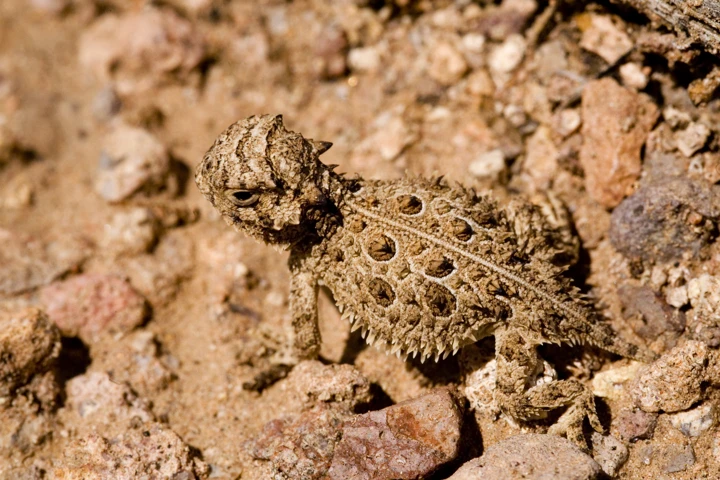
Texas horned lizard hatchling; an illustrative species photo, not a release-program photograph. Patrick Alexander · CC0
SAN ANTONIO ZOO / AZA ·
Released lizards turn up again in the wild
San Antonio Zoo researchers rediscovered a lizard hatched at the zoo in 2025 and a female hatched in 2024. The older animal had survived for more than a year and reached adult size.
A third lizard’s belly markings did not match the zoo’s records. It might have been a wild-born offspring, but genetic work was still needed to establish its origin when this report appeared.
Why it matters: Following animals after release helps researchers learn whether a population can establish itself.
From the archives: older reports that help explain today’s efforts.
TPWD ·
A milestone at Mason Mountain
Texas Parks & Wildlife reported finding 18 hatchlings believed to be offspring of zoo-raised lizards released in 2019. The same announcement described a new release of 204 captive-raised hatchlings.
It was an encouraging step in a long-running partnership between wildlife biologists, universities, and zoos—not proof that the species had recovered across Texas.
Join the biologists preparing tiny hatchlings for a return to the wild. This ten-minute Texas Parks & Wildlife episode explains the restoration work and the tracking tags used to follow the lizards after release.
The episode includes a transcript for readers who would rather read than listen.